
Question & Answer
What kind of materials do you use for your cable conductor?
Our cable conductor is bunched by many pieces of Oxygen Free Copper wire with 99.99% purity.
What are the advantages for the linear low density polyethylene which you used for the insulation of your cable conductor compared to the general polyethylene?
Compared to the general polyethylene, the conductor insulation we used is weatherproof linear low density polyethylene,which has more dielectric strength, more tensile strength, more flexible, more environmental stress crack resistance, moreoil resistivity.
Why do you use twisted-pair technology to produce the balanced cables?
The twisted-pair technology will strengthen the cable structure and will also offset the electromagnetic interference and reduce the crosstalk.
What are the advantages and disadvantages from the spiral, braided and Aluminum Foil shielding?
The characteristic of spiral shielding is easy to be changed after bending, however, it’s advantages are small outer diameter of the cable jacket,flexible and low costs. It’s suitable for low frequency shielding. Braided shielding has an excellent shielding feature, especially for the high frequency shielding and the shielding characteristic is stable after bending, but the production efficiency is lower and the price is quite high.The shielding factor of Aluminum Foil shielding can be 100% and the cost is also low, but it is easy to be broken and not resistant to bending. Of course, we can use double shielding to make the shielding factor to be 100%. For example, spiral & Aluminum Foil shielding or braided & Aluminum Foil shielding
What is the difference between an unbalanced and a balanced cable?
Unbalanced cables are mostly used to connect guitars and amplifiers, Hi-Fi components or as a simple control cable. they consists of a signal wire and shielding
Balanced cables have two signal wires with their phase inverted by 180°(±). The opposite phase cancels out interference signals, which is why this type of cables are preferred for long transmission distances or sensitive, interference-prone components such as microphones and mixing boards, etc.
What’s the difference between diameter and cross-section?
The diameter in mm is a linear measure,the cross-section in mm² an area measure.For solid conductors and single wires the diameter is specified in mm. For inner conductors, witch consist of multiple single wires/braided wires, we quote the cross-section. The cross-section(A) can be calculated from the diamete (d) using the following formula: A = d²x Pi /4≈0.785 x d²
What is the difference between a plastic cable drum and an iron cable drum?
Compared with iron cable drum, the advantages of ROXTONE all-plastic cable drum are: lightness, pressure resistance, drop resistance, corrosion resistance, oil resistance, and no rust.The only disadvantage is that it is more expensive than iron cable drums.
What is the difference between CAT.5e, CAT.6 and CAT.7 network cables?
CAT.5e
Cat5 and Cat5e cables are physically similar, Category 5e Ethernet adheres to more stringent IEEE standards. “E” is for enhanced, meaning a lower-noise
version where the potential for crosstalk is reduced. Crosstalk is interference that transfers from adjacent wires.
Cat5e is the most common type of cabling used for deployments due to its ability to support Gigabit speeds at a cost-effective price. Even though both
Cat5 and Cat5e support a maximum frequency of up to 100MHz, Cat5e has completely replaced its predecessor. Gigabit Ethernet utilizes 4 data pairs in
comparison to Fast Ethernet which utilizes 2 data pairs.
Further, Cat 5e supports speeds of up to 1000 Mbps. It’s flexible enough for small space installations like residences, though it is still used in commercial
spaces. Of all the current cabling options, Cat5e is your least expensive option.
Keywords: 100-250Mhz / 1 Gbps / 100m.
CAT.6
Cat6 wiring can support up to 10 Gbps and frequencies of up to 250 MHz. While Cat5e cable features 1.5-2 twists per cm, Cat6 cables are more tightly
wound and feature 2 or more twists per cm. (The amount of twists per cm varies upon each cable manufacturer).
Cat6 cables also sport thicker sheaths in comparison to Cat5e. Though standard Ethernet supports distances of up to 100 meters, CAT6 cable only
supports 37-55 meters (depending on crosstalk) when transmitting 10 Gbps speeds. Its thicker sheath protects against Near End Crosstalk (NEXT) and
Alien Crosstalk (AXT).
Even though Cat6 and Cat6a cabling offer higher performance rates, many LANs still opt for CAT5e due to its cost-effectiveness and ability to support
Gigabit speeds.
Keywords: 250-500Mhz / 10 Gbps / 100m.
CAT.6a
Cat6a supports bandwidth frequencies of up to 500 MHz, twice the amount of Cat6 cable, and can also support 10Gbps like its predecessor. However,
unlike Cat6 cabling, Cat6a can support 10 Gigabit Ethernet at 100 meters. [Cat6 cabling on the other hand, can transmit the same speeds at up to 37 meters.]
Cat6a also features more robust sheathing which eliminates alien crosstalk (AXT) and improves upon the signal-to-noise ratio (SNR). “A” = augmented.
The stronger sheathing makes Cat6a cabling considerably thicker than Cat6, also making it less flexible to work with, and therefore, better suited for
industrial environments at a lower price point.
Keywords: 250-500Mhz / 10 Gbps / 100m.
CAT.7
Cat7 can also support 10 Gbps, but laboratory testing has successfully shown its ability to transmit up to 40 Gb at 50 meters and even 100 Gb at 15 meters.
The newer “Class F” cabling can support frequencies of up to 600 Mhz. That said, Cat7 has not been approved as a cable standard for telecommunications.
Cat7 offers extensive shielding to reduce signal attenuation and is relatively stiff in comparison to previous generations of cabling. Both individual pairs are
shielded, with an additional layer of shielding over the entire cable. The shielding needs to be grounded and Cat7 also requires special GigaGate45 (GG45)
connectors to take full advantage of higher performance features.
All in all, Cat6a can perform just about the same as Cat7 but at a lower price point. Most of our AV and IP surveillance customers opt for Cat6a STP or Cat6a
FTP. Both offer shielding from alien crosstalk and interference around high voltage lines.
Cat7 is suited for use in datacenters and large enterprise networks.
Keywords: 600Mhz / 10Gbps / 100m (40m at 50m / 100Gbps at 15m).
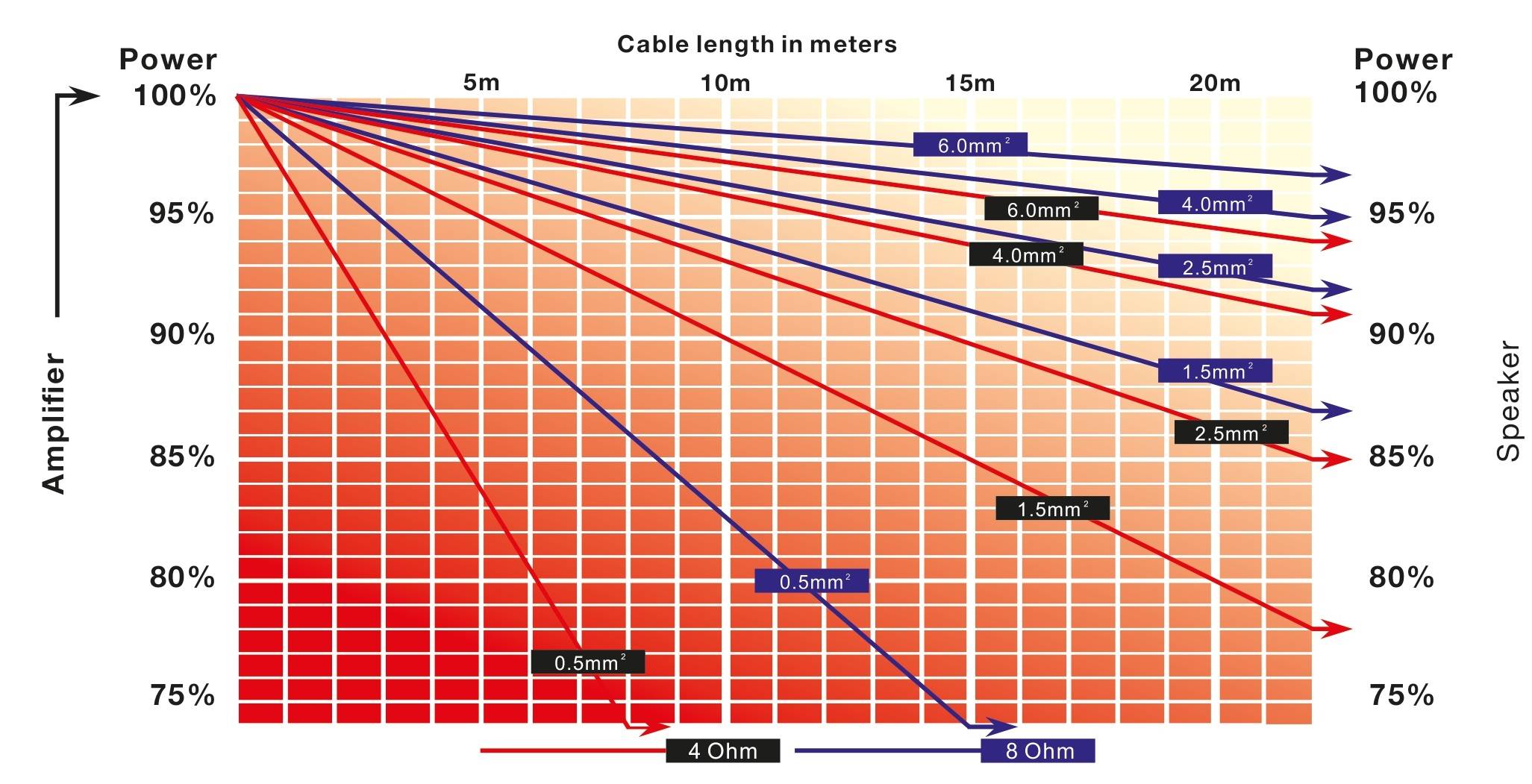
How to choose a correct speaker cable?
The below chart shows the relationship between the signal attenuation and the length of speaker cable and the conductor cross section.
What is IP Code?
The IP Code, or Ingress Protection Code is defined in IEC standard 60529 which classifies and rates the degree of protection provided by mechanical casings
and electrical enclosures against intrusion, dust, accidental contact, and water. It is published by the International Electrotechnical Commission (IEC).
The equivalent European standard is EN 60529.
The standard aims to provide users more detailed information than vague marketing terms such as waterproof. For example, a cellular phone rated at IP68
is “dust resistant” and can be “immersed in 1.5 meters of freshwater for up to 30 minutes”. Similarly, an electrical socket rated IP22 is protected against
insertion of fingers and will not be damaged or become unsafe during a specified test in which it is exposed to vertically or nearly vertically dripping water.
IP22 or IP2X are typical minimum requirements for the design of electrical accessories for indoor use.
The digits indicate conformity with the conditions summarized in the tables below. The digit 0 is used where no protection is provided. The digit is replaced
with the letter X when insufficient data has been gathered to assign a protection level.
This article summarizes a combination of IEC 60529 (also EN 60529) and other standards, such as ISO 20653. The original documents are available for
purchase, and have important and specific requirements that cannot be fully reprinted due to copyright restrictions. This often includes drawings
specifying the required test equipment, such as the shape of water nozzles used for water jet testing. Additional standards are often referenced that may
contain important information. One must refer to the latest revision of the required standard when conducting formal tests for agency certification.
Code breakdown
This table shows what each digit or part of the IP code represents.
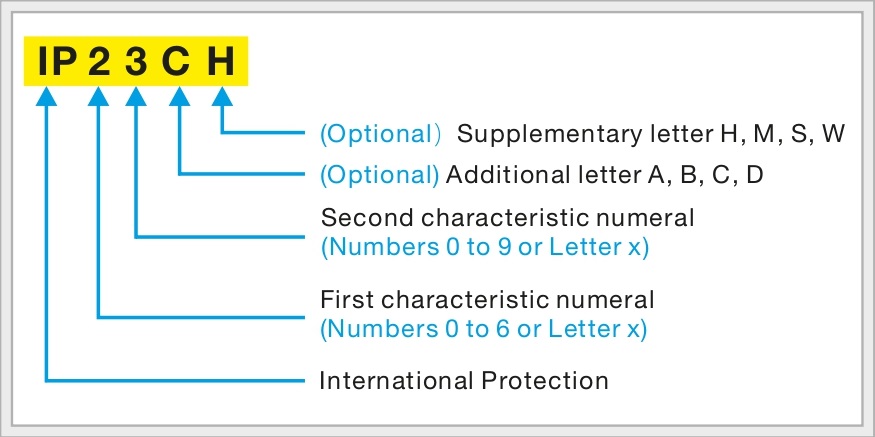
Additional letter (optional)
For the protection of personnel against
access to hazardous parts with:
| Letter | Meaning |
|---|---|
| A | Back of hand |
| B | Finger |
| C | Tool |
| D | Wire |
Supplementary letter (optional)
For the protection of equipment specific to:
| Letter | Meaning |
|---|---|
| H | High voltage apparatus |
| M | Motion during water test |
| S | Stationary during water test |
| W | Weather conditions |
| Code letters | First characteristic numeral: Solid particle protection | Second digit: Liquid ingress protection | Third digit: Mechanical impact resistance | Additional letter: Other protections | Supplementary letter: Other protections |
|---|---|---|---|---|---|
| IP (International Protection) | Single numeral: 0–6 or letter X | Single numeral: 0–8 or letter X | Single numeral: 0–9 | Single letter | Single letter |
| Mandatory | Mandatory | Mandatory | No longer used | Optional | Optional |
First digit: Solid particle protection
The first digit indicates the level of protection that the enclosure provides against access to hazardous parts (e.g., electrical conductors, moving parts)
and the ingress of solid foreign objects.
| Level sized | Effective against | Description |
|---|---|---|
| X | — | X means there is no data available to specify a protection rating with regard to this criterion. |
| 0 | — | No protection against contact and ingress of objects |
| 1 | > 50 mm (2.0 in) | Any large surface of the body, such as the back of a hand, but no protection against deliberate contact with a body part |
| 2 | > 12.5 mm (0.49 in) | Fingers or similar objects |
| 3 | > 2.5 mm (0.098 in) | Tools, thick wires, etc. |
| 4 | > 1 mm (0.039 in) | Most wires, slender screws, large ants etc. |
| 5 | Dust protected | Ingress of dust is not entirely prevented, but it must not enter in sufficient quantity to interfere with the satisfactory operation of the equipment. |
| 6 | Dust-tight | No ingress of dust; complete protection against contact (dust-tight). A vacuum must be applied. Test duration of up to 8 hours based on airflow. |
Second digit: Liquid ingress protection
The second digit indicates the level of protection that the enclosure provides against harmful ingress of water. The ratings for water ingress are not cumulative beyond IPX6.
A device that is compliant with IPX7 (covering immersion in water) is not necessarily compliant with IPX5 or IPX6 (covering exposure to water jets).
A device that meets both tests is indicated by listing both tests separated by a slash, e.g. IPX5/IPX7.
| Level | Protection against | Effective against | Details |
|---|---|---|---|
| X | — | — | X means there is no data available to specify a protection rating with regard to these criteria. |
| 0 | None | — | No protection against ingress of water |
| 1 | Dripping water | Dripping water (vertically falling drops) shall have no harmful effect on the specimen when mounted in an upright position onto a turntable and rotated at 1 RPM. | Test duration: 10 minutes Water equivalent to 1 mm (0.039 in) rainfall per minute |
| 2 | Dripping water when tilted at 15° | Vertically dripping water shall have no harmful effect when the enclosure is tilted at an angle of 15° from its normal position. A total of four positions are tested within two axes. | Test duration: 2.5 minutes for every direction of tilt (10 minutes total) Water equivalent to 3 mm (0.12 in) rainfall per minute |
| 3 | Spraying water | Water falling as a spray at any angle up to 60° from the vertical shall have no harmful effect, utilizing either: a) an oscillating fixture, or b) A spray nozzle with a counterbalanced shield. Test a) is conducted for 5 minutes, then repeated with the specimen rotated horizontally by 90° for the second 5-minute test. Test b) is conducted (with shield in place) for 5 minutes minimum. | For a spray nozzle: Test duration: 1 minute per square meter for at least 5 minutes Water volume: 10 liters per minute (0.037 impgal/s) Pressure: 50–150 kPa (7.3–21.8 psi) For an oscillating tube: Test duration: 10 minutes Water volume: 0.07 liters per minute (0.00026 impgal/s) per hole |
| 4 | Splashing of water | Water splashing against the enclosure from any direction shall have no harmful effect, utilizing either: a) an oscillating fixture, or b) A spray nozzle with no shield. Test a) is conducted for 10 minutes. b) is conducted (without shield) for 5 minutes minimum. | Oscillating tube: Test duration: 10 minutes, or spray nozzle (same as IPX3 spray nozzle with the shield removed) |
| 5 | Water jets | Water projected by a nozzle (6.3 mm (0.25 in)) against enclosure from any direction shall have no harmful effects. | Test duration: 1 minute per square meter for at least 3 minutes Water volume: 12.5 litres per minute Pressure: 30 kPa (4.4 psi) at distance of 3 meters (9.8 ft) |
| 6 | Powerful water jets | Water projected in powerful jets (12.5 mm (0.49 in)) against the enclosure from any direction shall have no harmful effects. | Test duration: 1 minute per square meter for at least 3 minutes Water volume: 100 liters per minute (0.37 impgal/s) Pressure: 100 kPa (15 psi) at distance of 3 meters (9.8 ft) |
| 6K | Powerful water jets with increased pressure | Water projected in powerful jets (6.3 mm (0.25 in) nozzle) against the enclosure from any direction, under elevated pressure, shall have no harmful effects. Found in DIN 40050, and not IEC 60529. | Test duration: at least 3 minutes Water volume: 75 liters per minute (0.27 impgal/s) Pressure: 1,000 kPa (150 psi) at distance of 3 meters (9.8 ft) |
| 7 | Immersion, up to 1 meter (3 ft 3 in) depth | Ingress of water in harmful quantity shall not be possible when the enclosure is immersed in water under defined conditions of pressure and time (up to 1 meter (3 ft 3 in) of submersion). | Test duration: 30 minutes. Tested with the lowest point of the enclosure 1,000 mm (39 in) below the surface of the water, or the highest point 150 mm (5.9 in) below the surface, whichever is deeper. |
| 8 | Immersion, 1 meter (3 ft 3 in) or more depth | The equipment is suitable for continuous immersion in water under conditions which shall be specified by the manufacturer. However, with certain types of equipment, it can mean that water can enter but only in such a manner that it produces no harmful effects. The test depth and duration is expected to be greater than the requirements for IPx7, and other environmental effects may be added, such as temperature cycling before immersion. | Test duration: agreement with manufacturer Depth specified by the manufacturer, generally up to 3 meters (9.8 ft) |
| 9K | Powerful high-temperature water jets | Protected against close-range high pressure, high-temperature spray downs. Smaller specimens rotate slowly on a turntable, from 4 specific angles. Larger specimens are mounted in the intended position when being used, no turntable required, and are tested freehand for at least 3 minutes at a distance of 0.15–0.2 meters (5.9 in–7.9 in). The specific requirements for the test nozzle are shown in figures 7, 8, & 9 of IEC (or EN) 60529. This test is identified as IPx9 in IEC 60529. | Test duration: Fixture: 30 sec. in each of 4 angles (2 min. total), Freehand: 1 min/m2, 3 min. minimum Water volume: 14–16 liters per minute (0.051–0.059 impgal/s) Pressure: 8–10 MPa (80–100 bar) at distance of 0.10–0.15 meters (3.9 in–5.9 in) Water temperature: 80 °C (176 °F) |
Why use low smoke zero halogen cable?
Low smoke zero halogen (Low smoke zero halogen), referred to as LSZH, LSOH, LS0H, LSFH and OHLS, is the classification of wire sheath materials in the wire and cable industry. The low-smoke halogen-free wire sheath is composed of thermoplastic or thermosetting which has low smoke emission when heated and is halogen-free . Most of the network wire coating is composed of polyethylene, polyvinyl chloride or thermoplastic polyurethane. If it catches fire, chlorinated plastic will release toxic hydrogen chloride, and if it encounters water, it will produce hydrochloric acid. The low-smoke halogen-free materials will not release hydrogen halides or other acids during fire. Low-smoke halogen-free materials can reduce the toxic and corrosive gases produced when they burn. In poorly ventilated environments such as airplanes, train cars, or ships, low-smoke and halogen-free materials are often used. Low-smoke and halogen-free materials are also commonly used in the railway industry, because there are high-voltage lines under the railway or signal lines that transmit the position of the train. The use of low-smoke halogen-free materials also reduces the accumulation of toxic gases when the circuit is damaged due to fire or short circuit. Like in the railway industry or shipbuilding industry, one of the most important requirements is to protect personnel and equipment from toxic and corrosive gases. In these occasions, low-smoke and halogen-free materials are required to be used in the outer layer of the wires and cables.
What is the difference between a low delay network cable and a normal network cable?
For an excellent network cable, the delay deviation value is very important, because in most Ethernet technologies, 4 pairs of wires are used, especially Gigabit Ethernet uses 4 pairs of wires. The centering delay is very different, so the signal received at the sending end and the receiving end will also be obvious Time difference, although the receiving end can withstand some light delay changes, if it is a very large delay deviation, it is impossible to recombine these signals. There should be a delay of less than 50ns on a 100-meter link. The lower the delay offset, the better. Any delay below 25ns is excellent. A slight delay of 45 to 50ns is acceptable. .In terms of the production process and materials of the network cable, the lower the delay deviation value, the greater the difficulty of production, the higher the cost, and the better the performance of the network cable! The production standard of Roxtone’s professional ultra-low latency network cable is that the delay deviation of 100 meters is less than 15ns, which means greater process difficulty, higher production cost and better transmission performance. Few friends in the mass production use expensive Fluke testers to perform 100% full inspection of their products, because a set of professional Fluke testing equipment is worth more than 100,000 yuan, and each test is a wear and tear on the equipment, to ensure The accuracy of the test results, after 5,000 tests, it is necessary to replace the test interface worth more than 20,000 yuan.
Roxtone uses expensive Fluke testers to test every 100 meters of low-latency network cables that leave the factory, and provides one-to-one exclusive test reports to ensure customers a value-for-money experience.